
The Beginning of a Bridge: Our Story and Mission
- Anton Agov
- Mar 11
- 5 min read


Welcome to the official blog of the Bulgarian–Chinese Association for Traditional Chinese Medicine and Culture, a community dedicated to strengthening the cultural and medical ties between Bulgaria and China while promoting the knowledge and traditions of Traditional Chinese Medicine in Europe.
Our association was founded with the belief that medicine, culture, and shared history can bring people together across continents. Through education, dialogue, and collaboration, we aim to create a space where practitioners, students, scholars, and anyone interested in Chinese culture and holistic health can learn from one another.
This first blog post is not only an introduction to our association—it is also a story about the inspiration behind it. The roots of our mission are connected to a remarkable family legacy that links Bulgaria and China through medicine, humanitarian service, and cultural exchange.
A Legacy That Connects Two Nations
The story behind our association is closely connected to the lives of Zhang Sunfen and Gan Yangdao, the great-grandparents of the association’s director, Anton. Their lives represent an extraordinary chapter in the shared history of China and Bulgaria.
Gan Yangdao, 甘扬道, originally born Ianto Kaneti in the Bulgarian town of Kazanlak in 1910, became known as the “Bulgarian Norman Bethune.” After graduating from the Medical Faculty of Sofia University in 1935, he began his career as a physician dedicated to humanitarian service.
In 1936 he joined the International Brigades during the Spanish Civil War to fight against fascism. After the fall of the Spanish Republic, many surviving international doctors were interned in camps in southern France. In 1939, the International Medical Aid Committee for China recruited volunteer doctors from these camps to assist China in its resistance against Japanese aggression.
Gan Yangdao volunteered immediately.
Together with more than thirty international doctors and nurses, he traveled across continents to China to support the Chinese people during the war. After arriving in Hong Kong, the group was welcomed by Soong Ching-ling, a key supporter of international solidarity with China.
Gan Yangdao was later appointed leader of the Third Medical Unit of the Chinese Red Cross Medical Relief Corps in Guiyang, Guizhou. Over the next six years he served in multiple regions—including Hunan, Jiangxi, Guangxi, Yunnan, and Guizhou—providing medical care to soldiers and civilians during the war against Japanese aggression. His dedication earned him recognition from Chinese leaders, and he was received by figures such as Soong Ching-ling and Zhou Enlai.


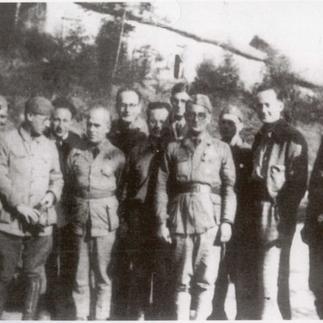
Zhang Sunfen – “The Voice of Chinese in the Land of Roses”
In 1940, Zhang Sunfen, a graduate of Yenching University’s nursing program in Beijing, traveled through Hong Kong and Vietnam to Guiyang in order to join the wartime medical relief efforts organized by the Chinese Red Cross.
Driven by a deep sense of responsibility during a time when the nation faced grave danger, she worked as an instructor responsible for training and organizing nurses within the wartime medical teams. It was at the medical headquarters at Tuyun Pass in Guizhou that she met Gan Yangdao. Sharing the same ideals of humanitarian service and international solidarity, the two soon fell in love and married in 1942.
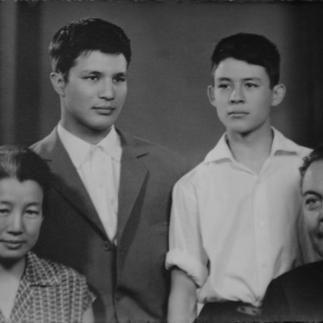
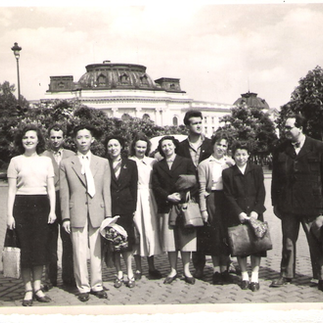
After the victory in the Second Sino-Japanese War and the broader World War II, the family eventually returned to Bulgaria, where both continued their work as cultural and educational pioneers.
Gan Yangdao later became a professor at the Medical Academy in Sofia, where he often spoke about China and his experiences during the war. Meanwhile, Zhang Sunfen became one of the pioneers of Chinese language and cultural studies in Bulgaria. Through her work she helped introduce generations of Bulgarian students to Chinese language, literature, and philosophy. She taught Chinese at Sofia University and contributed significantly to the early development of Chinese studies in the country. Among her most notable achievements was the compilation of the first Bulgarian–Chinese thematic dictionary, an important step in building academic and cultural understanding between the two nations. In addition to her academic work, she actively participated in cultural and educational initiatives that promoted Chinese culture in Bulgaria, serving for many years as a translator, educator, and cultural bridge between the two countries.
Because of her work and dedication, she became affectionately known as “the Chinese voice in the Land of Roses.”





Inspiration for our Association
Their lives demonstrate three powerful values that guide our work today:
1. Inspiration and commitment to ideals: Their actions show how strong values and belief in peace, solidarity, and humanitarian service can shape history.
2. Building connections through shared values: Their work helped create a lasting friendship between two nations that once knew little about each other.
3. Healing and understanding through knowledge: Their example reminds us that medicine is not only about treating illness, but also about caring for humanity as a whole.
In this spirit, our association seeks to promote Traditional Chinese Medicine, Chinese cultural heritage, and academic exchange, creating opportunities for cooperation between practitioners, researchers, students, and institutions.
Commemorating the 80th Anniversary of the Victory Over Japanese Aggression
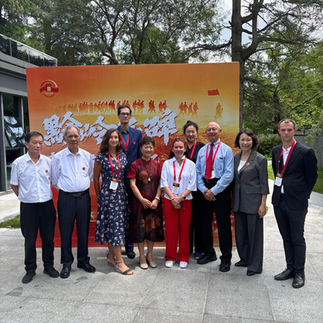
In 2025, members of the association participated in events commemorating the 80th anniversary of the victory in the Chinese People’s War of Resistance Against Japanese Aggression and the global victory in World War II.
These commemorations remind us that the solidarity shown by international doctors and volunteers—such as Gan Yangdao—played an important role in the global struggle against fascism.
Today, eighty years later, we honor that legacy by building bridges of culture, knowledge, and healing.





The Philosophy of Traditional Chinese Medicine
Traditional Chinese Medicine is not only a medical system but also a cultural and philosophical tradition that emphasizes balance, harmony, and the interconnectedness of life. Health, in this perspective, is not merely the absence of disease, but a result and reflection of harmony within the body and between the individual and the world around them; a reflection of the cosmos in miniature.
These principles resonate strongly with the mission of our association. By promoting not only the practical knowledge of Traditional Chinese Medicine but also the cultural and philosophical ideas that support it, we hope to foster a deeper understanding of health, well-being, and intercultural dialogue.
Our Mission Today
Today, the Bulgarian–Chinese Association for Traditional Chinese Medicine and Culture continues to build on this legacy by promoting knowledge, dialogue, and cooperation between Bulgaria, Europe, and China. We work to support the development and understanding of Traditional Chinese Medicine in Bulgaria and across Europe, while also encouraging academic and medical exchange between Chinese and Bulgarian institutions. Through the organization of educational programs, seminars, and cultural events, we seek to create opportunities for learning and collaboration. At the same time, we aim to support youth exchanges and cultural training opportunities in China, strengthening the long-standing friendship between Bulgaria and China through culture, medicine, and education. Through these efforts we hope to contribute to better health and deeper cultural understanding, and stronger international cooperation.
We warmly invite you to become a member of our Association!
Whether you are a practitioner, student, researcher, or simply curious about Chinese culture and holistic health traditions, we invite you to become part of our growing community.
Together, we hope to continue building a bridge of knowledge, health, and friendship between Bulgaria, Europe, and China.
Let the bridge between Bulgaria and China continue to grow.
Comments